The YouTube Ad-Blockers Living Inside Google's Own Walled Garden
YouTube is waging a public war on ad-blockers. Yet Google's own Chrome Web Store and Play Store host the very tools dismantling its ad network, and have handed two of them a “Featured” badge. We downloaded and decompiled them to see what's actually inside.
For three years, the message from YouTube to its viewers has been unambiguous: turn off your ad-blocker or lose access. In a global experiment confirmed in June 2023, the company began warning users that, “in extreme cases,” repeated ad-blocker use meant “playback will be temporarily disabled”, the so-called three-strikes rule.[1] By November 2023 YouTube even confirmed to The Register that it had “intentionally imposed a page-loading delay” for visitors running blockers.[2] And as Chrome wound down Manifest V2 through 2024-2025, the powerful webRequest blocking API that the full uBlock Origin depends on was switched off in favor of the more limited declarativeNetRequest, pushing Chrome users to the reduced-functionality uBlock Origin Lite.[3]
That is the front of the war. The back of it is stranger. The same company that throttles ad-blockers on YouTube is, on its own storefronts, hosting, ranking, and in some cases formally promoting the tools built to defeat them. A first-year university student's ad-blocking app sits at over a million Google Play downloads. A solo developer charges $2 a head for a Chrome extension that openly “uses YouTube's terms of service against them.” And an extension with ten million users (its entire stated purpose is blocking YouTube ads) carries Google's “Featured” badge.
None of this is hidden. It is sitting in the catalog, search-indexed, with star ratings and developer replies. What follows is a verified audit of how that contradiction looks from inside the store.
// How we verified this
Every figure below was read from the live Chrome Web Store or Google Play listing on May 31, 2026 and is a point-in-time snapshot. Install counts, ratings, and listings change.
For every browser extension, we did not rely on the store description. We downloaded the signed package directly from Google's extension update server (clients2.google.com/service/update2/crx), unpacked the CRX, and read the manifest.json and JavaScript ourselves to establish each tool's actual mechanism. Where a popular claim about an extension didn't survive that code review, we say so explicitly in a correction note rather than repeat it.
Quotes from developers and users are reproduced verbatim from public Reddit posts and the stores' own review tabs, with sources listed at the end.
§1The policy that says this shouldn't exist
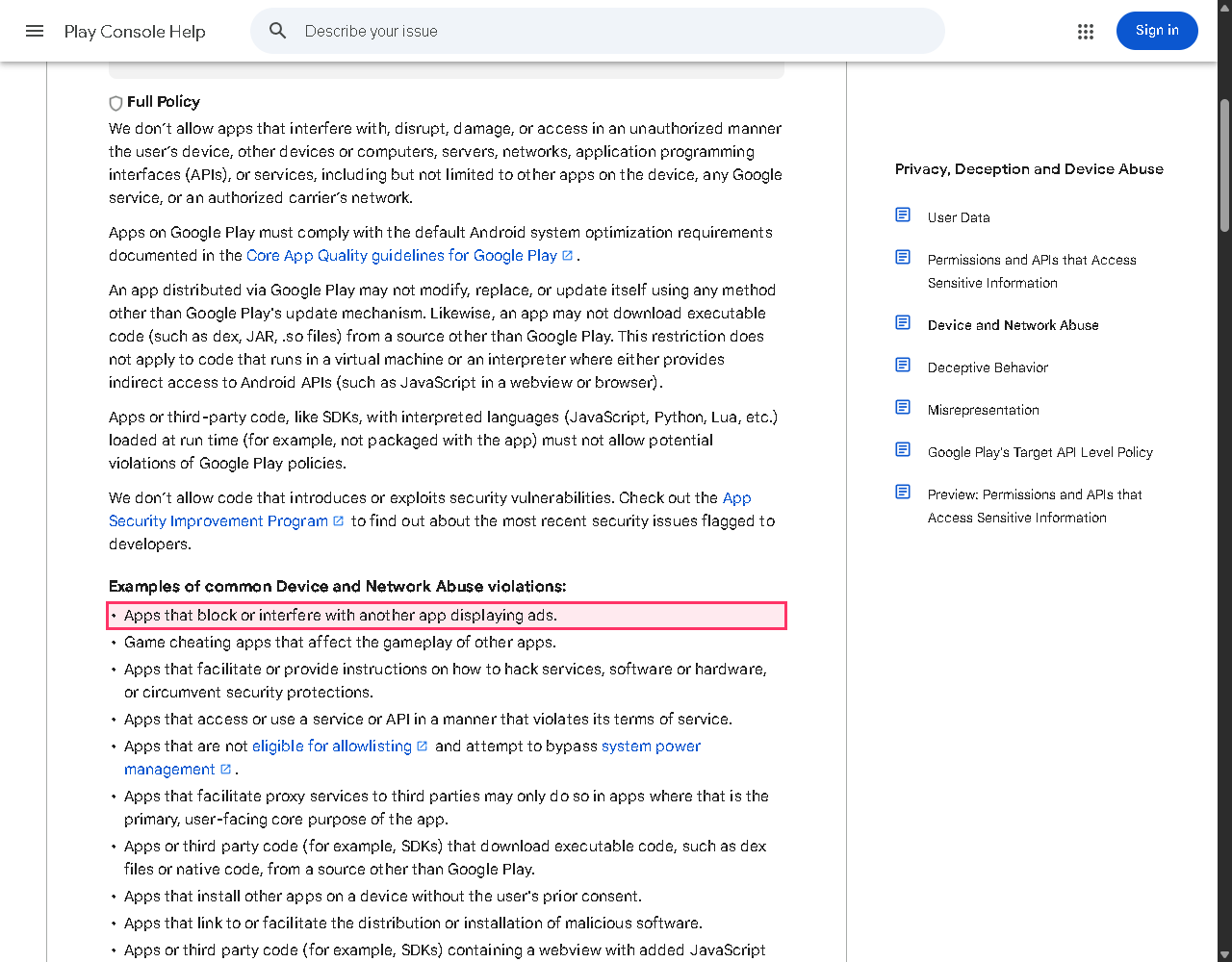
Start with what Google's own rules say. The Google Play Developer Program's Device and Network Abuse policy explicitly lists, as a violation, “Apps that block or interfere with another app displaying ads,” and, separately, “Apps that access or use a service or API in a manner that violates its terms of service.”[4] YouTube's own terms forbid interfering with its ads. Read literally, an app whose entire job is removing YouTube's ads sits squarely inside that prohibition.
The Chrome Web Store is more permissive: its program policies do not ban ad-blocking at all. They restrict circumventing paywalls or login restrictions, deceptive install tactics, and extensions whose own ads interfere with a site's ads, but content- and ad-blocking itself is allowed.[5]
So the contradiction is not that ad-blockers exist on Google's stores, broadly, they are permitted. It is that Google simultaneously treats YouTube ad-blocking as a punishable offense for viewers, while distributing, ranking, and monetizing the tools that perform it for developers. The clearest illustration is a $2 extension whose author will happily explain the trick to you himself.
§2The $2 blocker that turns YouTube's own player against it
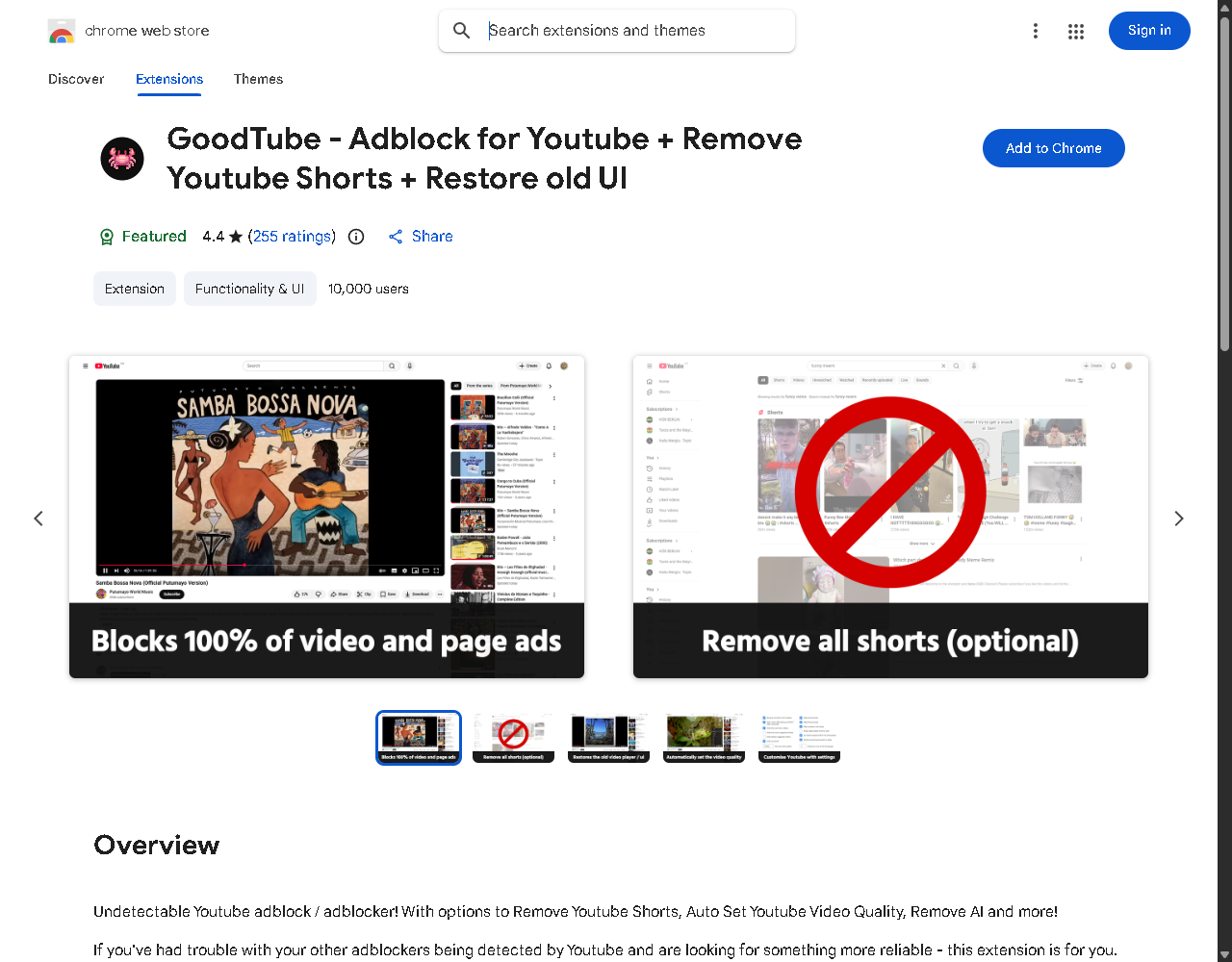
mnlobacbpcnaibnhmfcpdfllcipgnfhe- Users
- 10,000
- Rating
- 4.4 ★ (255 ratings)
- Developer
- GoodTube, Brisbane, QLD, AU
- Price
- $2 one-time, after a 7-day free trial (ExtensionPay / Stripe, PayPal fallback)
GoodTube is a paid extension. After a seven-day trial it asks for a single $2 payment, collected through the ExtensionPay/Stripe SDK bundled in its code, with a PayPal link as a fallback, all verifiable in its content.js and background.js.[6] The store description states the price plainly: “a 7 day free trial. After that it costs $2 (once only).”
The mechanism is the interesting part, and it is exactly what the developer claims. GoodTube does not use filter lists or network blocking, its only requested permission is storage. Instead, reading the unpacked source, it hides the native YouTube player and loads YouTube's own official embedded player (youtube.com/embed/<id>) inside an iframe, then injects CSS to strip the embed's controls and rebuilds a custom skin, seekbar, settings, keyboard shortcuts, so the swap is invisible. (To attach its script to that iframe it first bounces through a wikimedia.org?goodTubeProxy=1 proxy frame, a same-process trick.) Because YouTube's embedded player serves ads differently from the watch page, the ads simply don't appear.[6]
The developer, posting under the handle goodtube-xox, described the method and the business in a self-titled “my first extension now has over 10,000 users and has made over $7k!!” post on r/chrome_extensions, and spelled out the philosophy:
“So I released the second version, which replaced the normal video player with the ad-free embedded player. I then skinned the embed to look like the normal player… When it was finished you couldn't tell the difference. So it was a fully functional undetectable Youtube adblocker, no filter lists required.”
“…basically it uses Youtube's terms of service they have in place with their advertisers against them.” u/goodtube-xox, r/chrome_extensions (archived 2026-05-31)[7]
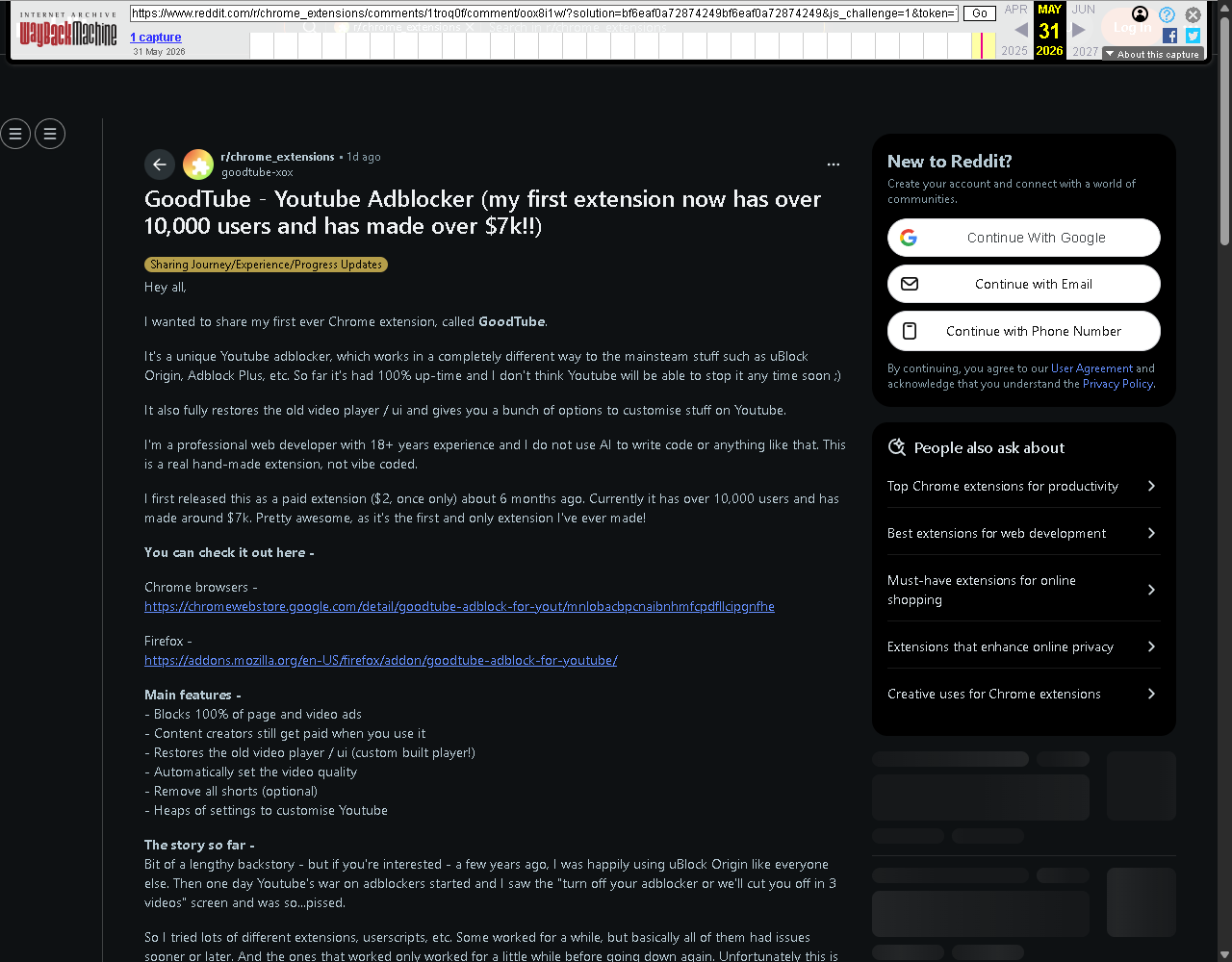
The “over $7k” figure is the developer's own self-reported, non-auditable claim; the 10,000-user count and $2 price, however, match both the store listing and the code. Users are aware exactly what they're buying. “amazing add blocker all for just $2 no monthy sub or anything,” wrote reviewer Embo_ on April 25, 2026; “This dev is an angel.”[6]
§3The ten-million-user blocker Google calls “Featured”
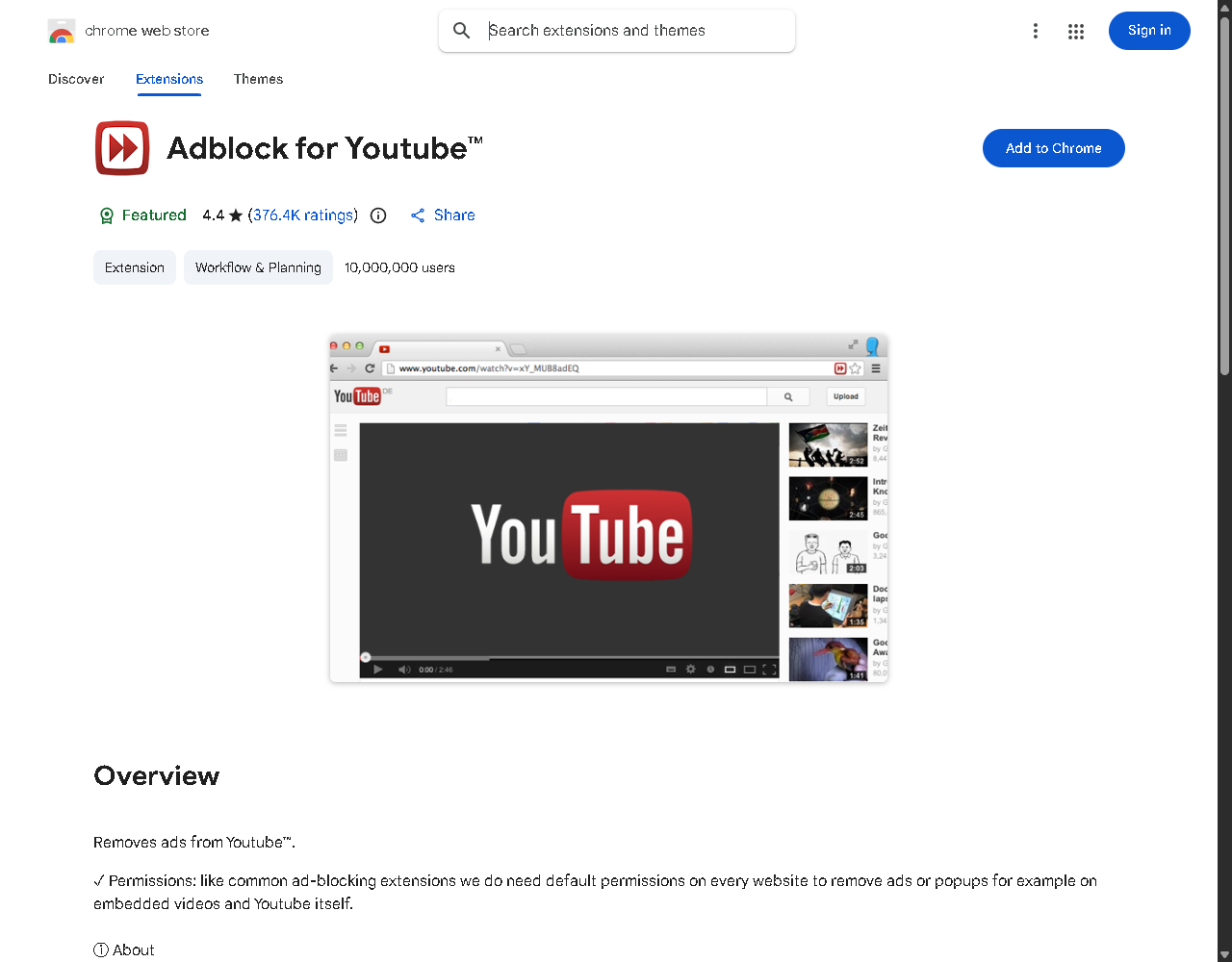
cmedhionkhpnakcndndgjdbohmhepckk- Users
- 10,000,000
- Rating
- 4.4 ★ (376,300 ratings)
- Developer
- AdBlock Ltd., Birkirkara, Malta
- Version
- 7.2.2 · Manifest V3
If GoodTube is a cottage operation, this is industrial scale. “Adblock for Youtube™” reports ten million users and over 376,000 ratings, a figure independently corroborated by the third-party tracker Extpose, and carries Google's “Featured” badge.[8] Its single stated purpose, per the listing, is “Removes ads from Youtube™.” Recent reviews are mundane and positive: “it just works,” wrote one user on the day we captured the listing.[8]
This listing has a documented dark chapter. Its name turns up in malware-removal guides that call it adware and a “browser hijacker,”[9] and a Hacker News post noted that Chrome itself flagged an “AdBlock for YouTube” as “contains malware.”[10] It also surfaced in a McAfee community thread about a “10 million user” adware extension.[11] And this is not just a name collision: in August 2023, r/youtube users traced a wave of fake ads and redirects to this exact extension ID (
cmedhionkhpnakcndndgjdbohmhepckk) and confirmed that removing it fixed the problem,[12] and by September it was being described as “officially classified as malicious after the redirect problem.”[13] The malware-guide screenshot shows the matching listing: the same red icon and promotional artwork, the “Featured” badge, and 10,000,000+ users (4.5★, 272,794 ratings, March 2023).
The build shipping today, though, tells a different story. We downloaded and decompiled the current version (7.2.2, May 2026, now listed under “AdBlock Ltd.”) and found a conventional Manifest V3 ad-blocker:
declarativeNetRequest rules, cosmetic CSS, and standard, bundled AdGuard/uBO scriptlets that null out YouTube's ad objects, with no eval, no remote code execution, and no browsing data leaving the browser beyond a version/extension-ID ping on install. Extensions can change hands and behavior over time, and this one appears to have. So the malware history is real and documented against this very ID; the code shipping now does not bear it out.[8]
That is arguably the more damning finding for the “contradiction” thesis. And whatever happened in 2023, the build shipping today reviews as an ordinary, ten-million-user ad-blocker, one that Google's own store curators have kept “Featured” throughout.
§4FadBlock and the honesty of “the ad is technically loaded”
lmnhcklabcehiohmmeihcheoegomkghm- Users
- 50,000
- Rating
- 3.4 ★ (330 ratings)
- Developer
- 0x48piraj (“Piyush Raj”)
- Mechanism
- Seeks ad video to its end
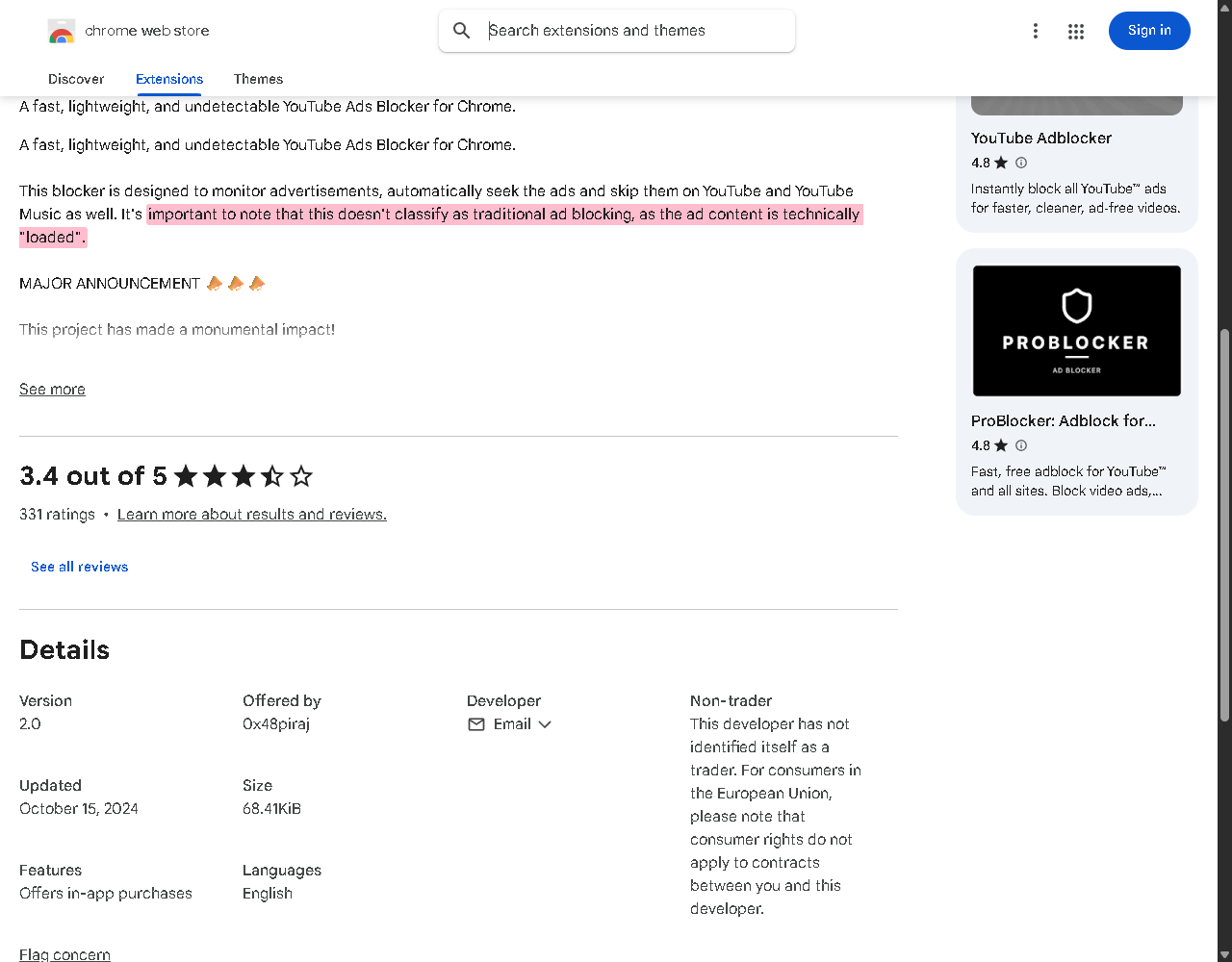
FadBlock takes a different route, and one widely mis-described online, including in an earlier draft of this very piece. The popular shorthand is that it “speeds the ad up,” finishing a 30-second spot in milliseconds. That is not what the code does.
FadBlock does not change playback speed. In
js/background.js, a function named taimuRipu briefly monkey-patches the video element's play() method and sets this.currentTime = this.duration: it seeks the ad straight to its end, then restores the original method. The playhead jumps past the ad instantly; nothing is accelerated, muted, or click-skipped. Ad-detection selectors are fetched at runtime from the developer's GitHub. Skipping is gated behind the same ExtPay paid/trial model as GoodTube.[14]
What makes FadBlock notable is its candor. Its store listing openly concedes the gray zone: the tool “automatically seek[s] the ads and skip[s] them,” and “this doesn't classify as traditional ad blocking, as the ad content is technically 'loaded.'”[14] Whether YouTube's servers then count that as a completed view is not something the extension's code can prove. Its reviews, meanwhile, are a graveyard of cat-and-mouse: “doesn't work” (May 27, 2026); “I paid for this and it doesn't even work” (Nov 13, 2024), to which the developer replied, “Hey, I'm currently working on a fix.”[14]
§5The rest of the shelf
GoodTube's iframe trick is the exotic one. The bulk of the YouTube-ad-blocking shelf runs on the now-standard Manifest V3 toolkit: declarativeNetRequest network rules, cosmetic CSS to hide ad slots, and main-world scriptlets that null out YouTube's ad objects in the player response. None of the extensions below use GoodTube's player-swap. Their install counts, ratings, and decompiled mechanisms, as of May 31, 2026:
| Extension | Users | Rating | What the code actually does |
|---|---|---|---|
| Adblock Unlimited jiaopkf… |
100,000 | 3.9 ★ 1K |
Full uBO/AdGuard-style engine (14,562-rule default list + cosmetic filtering). YouTube handling is the crudest: hides ad nodes and auto-clicks the “Skip” button every 7ms.[18] |
| Luna Adblock for Youtube ehfcopl… |
90,000 | 3.9 ★ 263 |
The most sophisticated: proxies JSON.parse/fetch/XHR to prune ad keys, neutralizes YouTube's 17-second anti-adblock stall, and tears down the “ad blockers violate YouTube's Terms” dialog.[16] |
| Adblock for YouTube™ pginocl… |
40,000 | 4.6 ★ 3.1K |
The lightest: just 8 network rules + CSS hiding + one uBO set-constant scriptlet. Its high rating is buoyed by an in-product “please review us” prompt.[17] |
| RedBlock kgmeeea… |
10,000 | 4.3 ★ 23 |
Network blocking + CSS hiding + scriptlets nulling adPlacements/playerAds, with filter rules refreshed from redblock.cc.[15] |
The reviews double as a real-time leaderboard of the arms race. “it bypasses youtubes anti-adblock system, great replacement after ublock got sniped,” one RedBlock user wrote in September 2025; by March 2026 another reported it had stopped working.[15] Luna's reviewers describe the telltale signature of its approach, “it fast forwards video ads and removes banner ads, but youtube freezes whenever loading a video.”[16] The tools break; the developers patch; the shelf stays stocked.
§6On mobile: a million downloads, an “ad-blocker” that shows ads
com.sgebrelibanos.aderaser- Downloads
- 1,000,000+
- Rating
- 3.4 ★ (45K reviews)
- Developer
- S & G Apps L.L.C.
- Labels
- “Contains ads” · “In-app purchases” · Teen
- Updated
- May 26, 2026 (v10.3.4)
The blind spot extends to Android. CleanTube, “an ad free app,” per its own listing, whose feature list includes “Block Ads for Videos” while featuring a screenshot of Youtube, has passed one million downloads on Google Play.[19] This is the app that Google Play's Device and Network Abuse policy, read literally, describes as a violation.
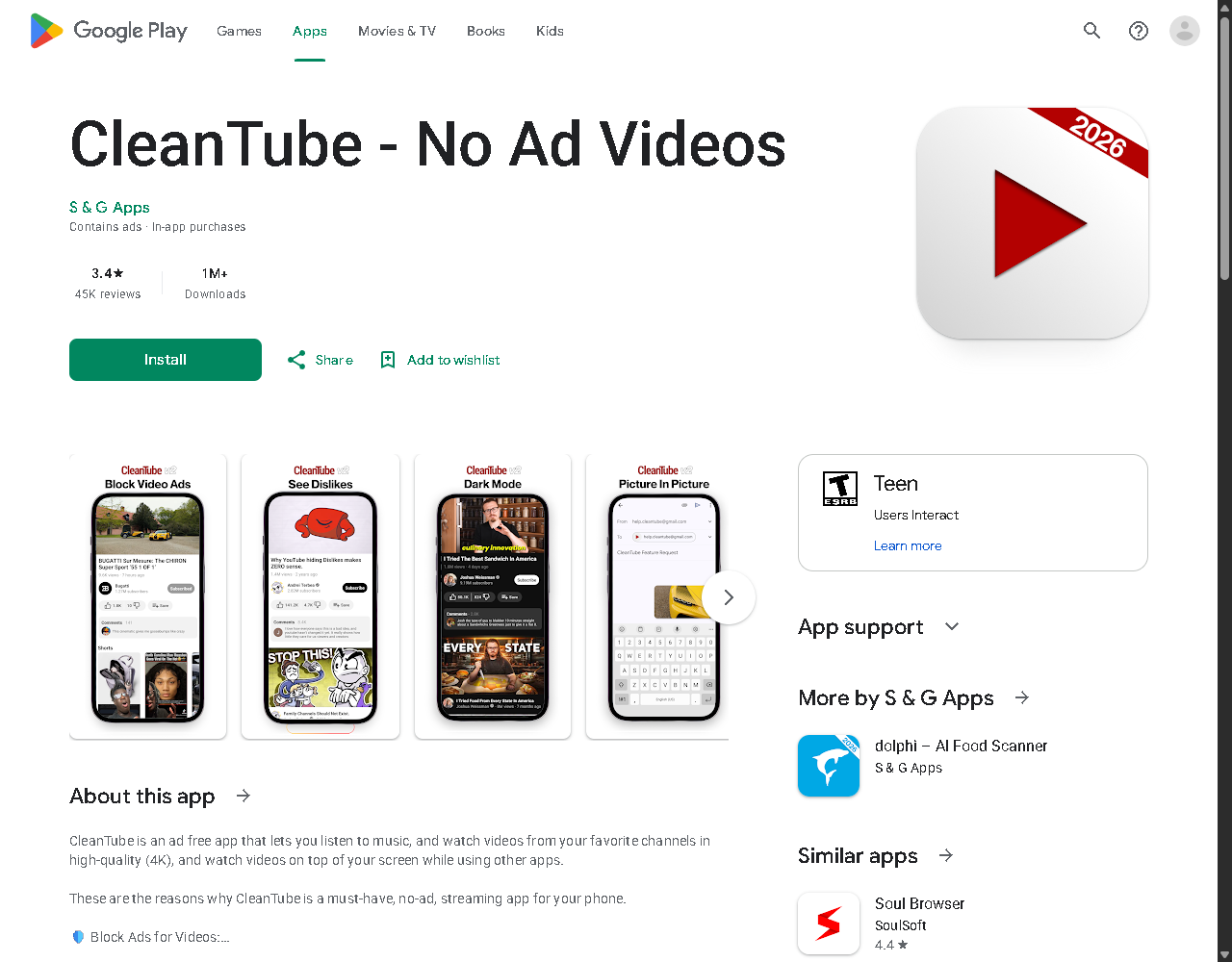
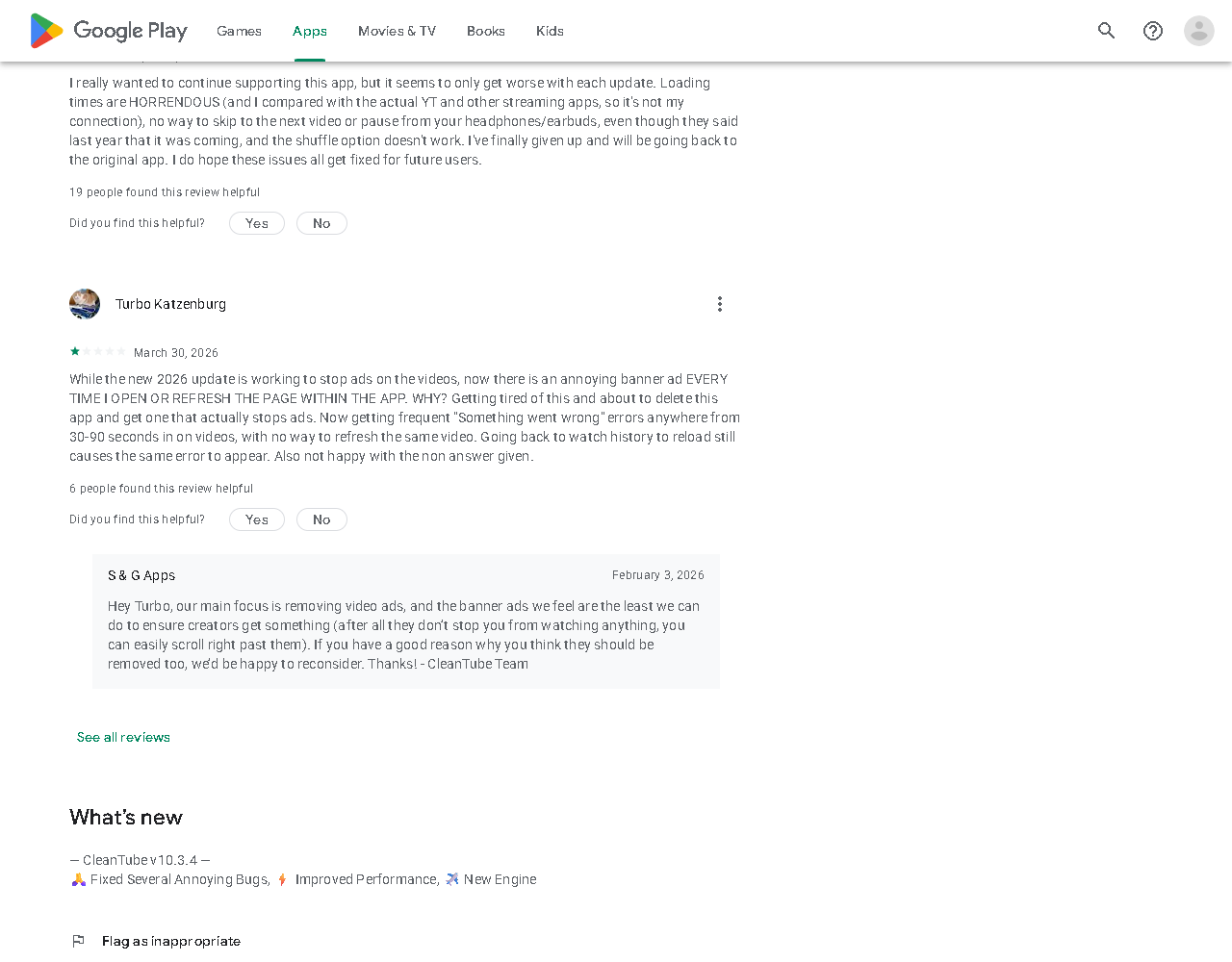
There is a small irony folded inside the larger one. CleanTube carries Google Play's “Contains ads” label: an ad-removal app that serves its own ads. A reviewer complained in March 2026 of “an annoying banner ad EVERY TIME I OPEN OR REFRESH.” The developer's reply, posted publicly on the listing, doesn't dispute it:
“our main focus is removing video ads, and the banner ads we feel are the least we can do to ensure creators get something.” S & G Apps, developer reply, Feb 3, 2026[19]
CleanTube is also a reminder that these tools are not the work of anonymous bad actors. The app is published by S & G Apps, founded by Summon Gebrelibanos. In a recorded 2022 interview, in which he says he was then a 14-year-old in the 10th grade, he demonstrated CleanTube and described its purpose plainly:
“I recently released an app called CleanTube that can block YouTube advertisements on your phone and computer. I've been working on it this summer and I just released it, so I'm working on a future TV version as well.” Summon Gebrelibanos, recorded interview, 2022 (~1:28)[21]
In the same interview he pitched the app explicitly as a free substitute for YouTube's paid tier. CleanTube does “anything I actually can do on YouTube,” he said, listing ad-blocking, in-video sponsorship removal, video downloads, and TV casting, all of it “completely free without paying that … a month that you would have to for YouTube Premium.”[21] Gebrelibanos has since been listed publicly as an “Undergraduate Student Researcher” at Northwestern University's Design, Technology & Research lab, described there as “a first-year computer engineering student” who “loves building things.”[20] An identifiable developer, a named company, a public store page, a million installs, none of it concealed.

§7What the audit shows
The point is not that these tools are malicious today, and the scariest claim we chased, that the ten-million-user blocker is malware, held for its 2023 build but not the code shipping now. The point is the shape of the contradiction. Across both of Google's own storefronts, the company distributes, ranks, and in two cases formally features the precise category of tool that YouTube punishes its viewers for using and that Google Play's own abuse policy describes as a violation.
Automated review can read syntax; it cannot read a $2 price tag attached to “undetectable Youtube adblock,” or a developer's Reddit post explaining the bypass in plain English, or a listing that calls itself ad-free while wearing a “Contains ads” label. Until that contradiction is resolved at the policy level rather than the player level, the war on ad-blockers will keep being fought against the people watching YouTube, and not against the storefront selling them the way out.